
Entry into Year 7 (September 2027)

For Year 7 admissions prior to September 2027, please see the relevant policy on the School Policies page.

Please note that the School is responsible for organising testing arrangements and all applicants need to register to be tested. No applicants will be entered automatically.

Test registration opens at 12:00 pm (noon) on Monday, 13 April 2026 and closes at 12:00 pm (noon) on Monday, 31 August 2026. If you do not register your child to be tested by the deadline, any application to join the School will only be considered after the date in March 2026 when school places are allocated.

Parents are advised to read all documents carefully.
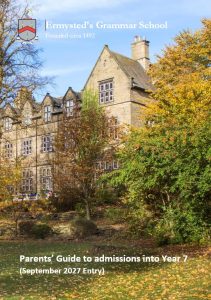
Summary of the admissions process for entry into Year 7 in September 2027

The information is taken from the 2026-27 Admissions Policy. Please see the policy document for full details.

Key Dates

  • Registration Opens: 12:00 pm on Monday, 13 April 2026
  • Registration Closes: 12:00 pm on Monday, 31 August 2026
  • Main Entrance Test Date on Saturday, 26 September 2026
  • Test outcome released in the week commencing 12 October 2026
  • Common Application Deadline on Saturday, 31 October 2026
  • Supplementary Information Form deadline on Friday, 27 November 2026
  • National Offer Day is Monday, 1 March 2027

Eligibility

  • Age: Boys born between 1 September 2015 and 31 August 2016
  • Gender: As a boys’ grammar school, applicants must be male
  • Test Attempts: Each applicant may sit the entrance test only once

Registration Process

  • All applicants must register for the entrance test—even those in the catchment area
  • How to Register:
    • Online via the school website
    • Or by submitting a hard copy to the School Office
  • Registrations after the deadline are considered late and will only be reviewed after March 2027, when initial offers are made

Entrance Test

  • Provider: Future Stories Community Enterprise Ltd (FSCE)
  • Format: Two papers covering:
    • English and mathematics questions with multiple choice answer options
    • English and mathematics questions where you respond with short written answers
  • Standardisation: Scores are standardised and age-weighted to ensure fairness
  • Special Arrangements: Available for candidates with disabilities or additional needs—must be requested during registration

Selection & Offers

  • Places Available: 128 (Published Admission Number)
  • Selection: The ‘required standard’ for admission to Year 7 in September 2027 will be determined by the Admissions Committee based on the performance of candidates in the main Entrance Test cohort
  • Oversubscription Criteria (if more than 128 reach the required standard and apply to the school):
    1. Looked-after or previously looked-after children
    2. Applicants in the catchment area
    3. Applicants outside the catchment area

Preference to children in the second and third priority will be applied in the following order:

    1. Pupil Premium eligible children
    2. Siblings of current pupils
    3. Proximity to the school (straight-line distance)

Post-Test Process

  • Parents are informed of test outcomes in the week commencing 12 October 2026
  • Parents must still complete the Common Application Form (CAF) via their Local Authority
  • The Local Authority will inform parents of the school place allocated to their child on National Offer Day, Monday, 1 March 2027.
  • Waiting List: Maintained until 31 December 2027

Admissions FAQ

Who is the Admissions Authority?

The Governing Body of Ermysted’s Grammar School (the ‘School’) is the Admissions Authority.

How many places are available?

The School has a Published Admission Number (‘PAN’) of 128 places in Year 7.

Who is eligible to sit the Entrance Test?

To be eligible to sit the Entrance Test and be considered for a place at the School in September 2027, an applicant must have been born between 1 September 2015 and 31 August 2016. For admissions outside of a child’s normal age group, parents should refer to the relevant section of the Admissions Policy. Please note, as a single sex boys’ school, eligibility will be based on the child’s gender being male. An applicant may only sit the Entrance Test once.

Do I need to register my child to sit the Entrance Test?

Yes.

Everyone, including those residing in the catchment area, needs to register.

How do I register for the Entrance Test?

Parents can submit the Entrance Test Registrations Form from 13 April 2026. Forms must be submitted via this website or submitted in hardcopy to the School Office. The deadline for registrations for the main testing session is 12:00 pm (noon) on 31 August 2026. All registrations received after this deadline will be considered as late and will not be considered in the first round of offers.

What if my child requires special arrangements?

For candidates who have a disability and/or require special resources to complete the Entrance Test, parents may request special arrangements be made by completing the relevant section of the Entrance Test Registration Form. Parents making such an application will be informed in writing by 14 September 2026 whether their request has been agreed. The deadline for registrations for the main testing session is 12:00 pm (noon) on 31 August 2026. All registrations received after this deadline will be considered as late and will not be considered in the first round of offers. Please see our Parents’ Guide for advice on special arrangements.

How is the ‘required standard’ determined?

The required standard will be determined by the Admissions Committee based on the performance of candidates in the main Entrance Test cohort.

When will I know whether my child has reached the required standard?

To allow time in which to complete the Common Application Form (‘CAF’), parents will be informed whether their child has met the required standard in the week commencing 12 October 2026.

Please note that achieving the required standard does not equate to the offer of a place at the School.

If my child has reached the required standard, does that guarantee admission to the School?

No.

Attaining the required standard does not guarantee admission to the School. If the School is oversubscribed by applicants who have reached the required standard, it will apply its oversubscription criteria until the PAN of 128 has been achieved.

What are the oversubscription criteria? (All terms are fully defined in the Admissions Policy)

Children with an Education, Health and Care Plan (EHCP) naming the School will be admitted. Should this occur it will reduce the number of places available. For other applicants achieving the required standard, there is no guarantee of a place at the School being available. If more applicants reach the required standard than there are places available, the following oversubscription criteria will apply:

First to children who have achieved the required standard and who are Looked-After or are Previously Looked-After, second to children who have achieved the required standard and whose home address lies within the catchment area at the time of application, third to children who have achieved the required standard and whose home address lies outside the catchment area at the time of application.

Preference to children in the second and third priority will be applied in the following order. First to children who are registered as in receipt of the Pupil Premium at the time of application, then to children who have a brother at the School in September of the year of entry, then to children who live closest to the School.

If two or more applicants fulfil the relevant criteria and live equidistant to the School, but there are not enough spaces remaining to accommodate them all, the available place(s) will be allocated at random. The process will be conducted in the presence of a witness who is independent of the School and its admissions process.

Do I need to apply for a place at the School?

Yes.

Registering for and sitting the Entrance Test is not an application for a place at the School. The parent must name the School on the Common Application Form (‘CAF’) and submit the CAF on time to the home local authority. The closing date for submitting the CAF is usually 31 October 2026 but it is the parent’s responsibility to contact their home local authority directly for further details.

Do I need to supply more information to the School?

In order to be able to apply the oversubscription criteria, the School must be informed of applicants who qualify for priority. This is achieved by the parents concerned submitting a Supplementary Information Form (‘SIF’) and including the necessary information and supporting evidence. The SIF needs only to be completed by parents who believe their child qualifies for priority under one of the oversubscription criteria.

When will I know if my child has been allocated a place at the School?

The Local Authority will notify the parents whether or not their child has been allocated a place at the School on 1 March 2027 and provide instructions on how parents can confirm whether they wish to accept the place or not. Failure to confirm the place within the indicated timeframe may lead to the offer being withdrawn.

Test FAQ

What is the FSCE Entrance Test?

The FSCE (Future Stories Community Enterprise) entrance test is a set of test papers used by some grammar schools to evaluate candidates for entry into Year 7. It assesses a range of academic abilities, inspired by (and not beyond) the Key Stage 2 National Curriculum taught up until the end of Year 5.

What subjects or skills are explored in the FSCE test?

The test includes:
English: assessing understanding of texts, and appropriate use of language. To identify candidates with strong command of the written word, who can read easily, fluently and with good understanding.
Mathematics: problem-solving, logical reasoning, and application of numeracy. To identify candidates whose fluency in the fundamentals of maths means that they are able to focus on grappling effectively with increasingly complex problems.

Non-verbal reasoning is not included in our test and there is no creative writing element.

How is the test different from other entrance tests?

The test has been designed with the child in mind. From familiar test layouts to accessible wording and content with a range of difficulty levels, all children will be able to ‘give it a go’ based on their commitment to working hard at primary school. A mix of multiple choice and constrained response tasks will be familiar to children from their primary school work.

What assurance is there that my child has been taught the test content?

Our tests only include Key Stage 2 curriculum content that will have been taught up until – and including – the end of Year 5.

Can my child prepare for the FSCE test?

Yes. Children will benefit by:
• Working well at primary school with maximum attendance and engagement in all areas of school life;
• Reading widely and regularly, with a focus on meaning;
• Practicing mental arithmetic in real-life scenarios and problem-solving puzzles;
• Engaging in reasoning and logic games that require imagination;
• Using the official Familiarisation Guides, which are available on the school website.

There is no need for intensive tutoring and no need for spending hours on past papers or mock exams. There are no commercial 11+ books or past papers endorsed by our test provider, FSCE. All relevant test information and sample questions are provided in our Familiarisation Guides.

Will we be given practice papers or familiarisation materials?

The school has Familiarisation Guides on its website to help children and their families understand the style and format of the questions. These resources are designed to be informative, provide familiarity, reduce anxiety and ensure fairness. No tutor, website, or company can claim to have any other knowledge about what the FSCE entrance test will be like or contain.

How long is the test and how many papers are there?

The structure can vary slightly but generally:
• There are two separate papers;
• Each paper typically lasts 45–60 minutes;
• A break will be scheduled between papers.

Specific details will be provided by the School in advance of the test.

How old should my son be when he takes the test?

To be eligible to sit the Entrance Test and be considered for a place at the School in Year 7 in September 2027, an applicant must have been born between 1 September 2015 and 31 August 2016.

For admissions outside of a child’s normal age group, parents should refer to the relevant section of the Admissions Policy. Please note that an applicant may only sit the Entrance Test once.

Where and when does the test take place?

The main testing session will take place at the School on the morning of Saturday, 26 September 2026.

What happens if something serious occurs near (or on) the day of the test which prevents my son performing to his best?

When you present your child for the Entrance Test it is expected that you are satisfied that there are no other circumstances that will prevent him from performing to his best. If anything serious has occurred that you believe will affect his performance, such as an illness or bereavement, you must advise the Admissions Officer via the School Office (01756 792186) or admissions@ermysteds.uk as soon as possible and no later than the relevant deadline (outlined above).

What if we miss the test?

If your child does not attend the test day and the School has not been notified of a valid reason by the relevant deadline, they will be withdrawn from testing. If you later wish your child to be tested, the application will be treated as per any other late applications.

What equipment should my son bring to the test?

None. The School will supply candidates with the necessary stationery.

Can my child bring drinks and a snack to the test?

Yes but drinks and snacks are to be consumed during the break in between the two papers. Drinks and snacks are not permitted during the Entrance Test. Please ensure that any snacks are placed in a clear plastic bag and it is labelled with his name.

Can my child go to the toilet during the test?

All candidates will be allowed to visit the toilet if and when they request it. However, if a toilet break is taken during one of the assessments, no additional time will be provided at the end.

Are there any items that my son must not bring to the test?

A clock will be clearly visible to candidates in each room. The use of electronic timers, dictionaries, calculators of any description (including calculator watches), or any potential internet enabled source of information is not permitted. Mobile phones, iPads, MP4 players, smart watches or any other electronic aids must not be brought to the test. Possession of unauthorised items, such as a mobile phone, is a serious offence and could result in disqualification from the examination.

How are the papers marked?

The mathematics and English responses are scanned and marked automatically using Optical Mark Recognition technology. The process is reliable and trustworthy.

The raw marks in each paper are then standardised and adjusted to account for differences in the age of the candidates. The process of standardisation is a statistical adjustment to ensure both papers have the same average score (100) and similar spread of results. This ensures that a low scoring performance in a difficult paper, say, has equal merit with a high score in an easier paper. Standardisation also ensures both papers have the same weight in determining the overall performance of each candidate.

The two standardised scores are added together to produce a candidate’s overall score. It is this value that is compared to the ‘required standard’ for admission in to Year 7. The required standard is determined each year by the Admissions Committee based on the performance of candidates in the main Entrance Test cohort.

At Ermysted’s

532
years

Established circa 1492

825
pupils

on roll

59
weekly

enrichment activities